How to read this appendix
This appendix provides the full scientific detail behind the subatomic section of Chapter 2. You do not need to read it to understand the rest of the book. The main text gives the conceptual model in plain language. Come here only if you want the rigorous physics that shows the same Thread operating at the smallest scales we know. The technical terms are used precisely, but the core insight — that finite interaction capacity leads to natural compartments and stable configurations — remains the same.
Start at the bottom and the same lesson appears immediately. The universe does not begin with solid objects but with restless particles and fields. Yet even there, not everything flies apart. Some relationships hold.
To see how this first layer of order works, it helps to know what we are actually looking at. Physicists have identified a surprisingly small set of fundamental building blocks. According to the Standard Model of particle physics there are twelve matter particles, six quarks and six leptons, plus a handful of force-carrying particles that transmit the interactions between them (R. P. Feynman, Leighton, and Sands 1963; R. Feynman 1965).
These twelve matter particles come in three generations or families. The first generation contains the lightest versions: two quarks (called “up” and “down”) and two leptons (the electron and the electron neutrino). The second and third generations are simply heavier copies of the same types. In total, then, we are talking about six different “flavors” of quarks and six different leptons.
Here is the crucial fact: almost none of them last. The heavier quarks and leptons from the second and third generations are extremely short-lived. They appear for only microseconds or less before they decay into lighter particles. They are part of reality’s restless exploration, but they do not stick around long enough to build anything durable.
Only the lightest, first-generation particles survive in any meaningful way. The up quark, the down quark, and the electron, together with their neutrinos, which, while stable, do not participate in the bound structures of ordinary matter, are the ones that make up essentially all the ordinary matter we encounter in daily life: your body, this page, the air, the Earth, and every star we can see. Everything else is transient.
Now the pattern that matters for our model begins to appear.
Take the quarks. Each quark has a limited capacity to interact with others through a property physicists call color charge. Left to themselves, quarks would keep reaching outward. Instead, they find partners. Three quarks, one of each color, bind together by constantly exchanging force-carrying particles called gluons. In this tight trio they saturate almost all of their available interaction capacity internally. The colors cancel out completely, and the resulting whole (a proton or a neutron) becomes effectively self-contained. External forces now have far less bandwidth to pull it apart.
This is compartmentalization arising directly from the parts themselves. What we call a proton is not a solid little ball. It is a stable regularity, a repeating pattern of quark interactions that holds together so reliably it behaves as a single, dependable unit. The proton is one of the most stable objects known: its lifetime is longer than 10^34 years, vastly longer than the current age of the universe. A free neutron decays in roughly fifteen minutes, yet inside an atomic nucleus it can last indefinitely. These are not fixed, unchanging things. They are the first reliable regularities that can be handed upward.
Figure 7: Subatomic Compartments
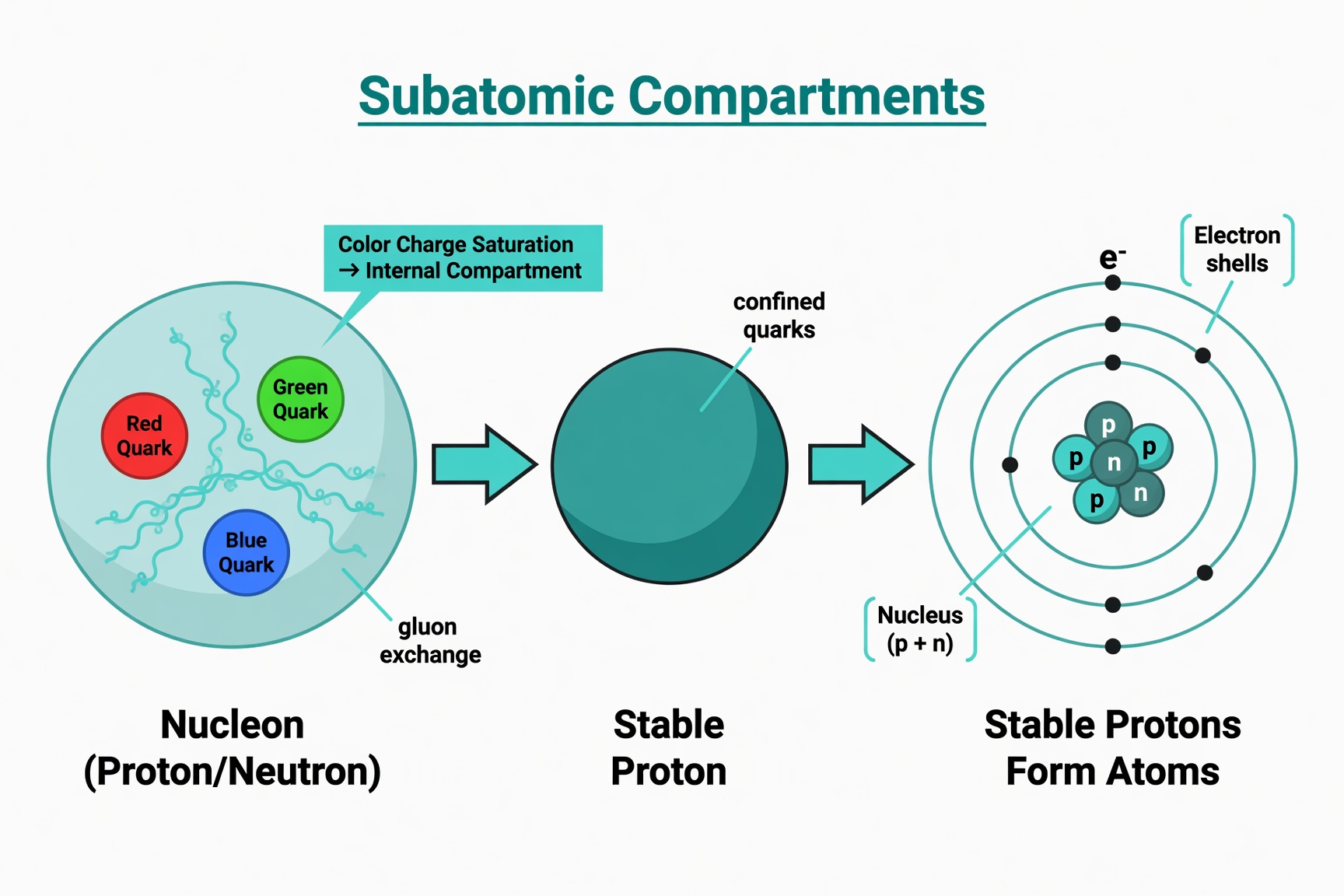
Figure 7: Quarks achieve compartmentalization through color charge saturation, forming extraordinarily stable protons that serve as building blocks for higher levels.
Over immense stretches of time, these stable particles build up in the hearts of stars. There they come together in fusion, forging heavier atoms while releasing a steady flow of energy that radiates outward, the very energy that will one day power chemistry on planets and the rhythms of life itself. The subatomic compartment thus becomes the first store of order whose surplus helps supercharge every higher level.
Stability Thresholds: Reality’s Selection Filter
Not every possible arrangement survives the test of time. At the subatomic level, particles and fields are in constant flux: they appear, combine, and dissolve in countless configurations. Most of these attempts are fleeting. Only those combinations that cross a critical stability threshold, a minimum level of internal saturation, coherence, and endurance, are permitted to persist long enough to become reliable building blocks.
This is the quiet, relentless operation of the Stability Drive. A proton exists only because three quarks achieve exactly the right color-charge saturation; anything less and the structure disintegrates almost instantly. Heavier quarks and leptons from the second and third generations flash into existence and decay in microseconds because they never reach the necessary threshold. Only the lightest, first-generation particles meet the criterion and endure.
The same gatekeeping appears at every higher level. An atom holds together only when its electrons settle into orbitals that satisfy the electromagnetic stability threshold. A molecule or cell persists only when its internal chemistry crosses the viability threshold protected by a membrane. A company survives only when its balance sheet, cash flow, and operations stay above the bankruptcy threshold. A human being continues only when vital systems, such as the heart and the brain, maintain their own unforgiving thresholds of integrity and function.
Stability thresholds are not arbitrary rules imposed from outside. They emerge naturally from the finite interaction capacity of the parts themselves. Below the threshold a configuration decomposes and returns to disorder. Above it, the arrangement becomes a stable configuration, a dependable new part that can be handed upward to the next layer of the hierarchy.
Electrons follow a similar story, though with a different force. They carry electric charge and interact through the electromagnetic force, transmitted by photons. Around a nucleus they settle into stable orbitals, cloud-like patterns where their own interaction capacity is again saturated internally. The entire atom becomes another natural compartment: not a hard little sphere, but a recurring regularity of electron behavior.
Most of the other particles in the Standard Model, W and Z bosons, muons, heavier quarks, live for tiny fractions of a second. They flash into existence and disappear. Reality has already run the long experiment across cosmic time and kept only the low-energy, long-lived regularities. The heavier particles are part of the search, but they are discarded by the same drive that favors arrangements that endure.
Those early regularities, quarks locked into protons and neutrons, electrons locked into atoms, become the first stable interaction patterns on which everything else depends. As Azarian notes in The Romance of Reality, simple rules, repeated across immense scales of time, can build surprising amounts of order (Azarian 2022).
Azarian, Bobby. 2022. The Romance of Reality: How the Universe Creates Itself and Why It Matters. BenBella Books.
Feynman, Richard. 1965. The Character of Physical Law. MIT Press.
Feynman, Richard P., Robert B. Leighton, and Matthew Sands. 1963. The Feynman Lectures on Physics. Addison-Wesley.