Chapter 2: A Hierarchy of Meaning
The first time I understood this chapter in my bones, it was not in a lab.
It was at a dinner table.
Everyone was technically present — but not really there. A phone buzzed. Someone answered a message. Another person drifted into work stress. We were sharing food, but not attention. The evening ended with a strange emptiness: we had spent time together without feeling together.
A week later, we changed one thing. Phones in a basket by the door. One small rule. Same people. Same table. Same food.
The mood changed quickly. Conversation deepened. People interrupted less. We laughed more. We remembered details from each other’s week. That one boundary protected the interaction. Within a month, dinner felt like a place we could return to — not just pass through.
That is the chapter in miniature.
A meaningful pattern became stable when it was protected.
A Second Scene: My Gaming Group
For more than a decade, I have played online with many of the same people at roughly the same time each week. From the outside, it looks like entertainment. From the inside, it became something else: rhythm, shared language, mutual reliability.
Why did it endure when so many casual friendships dissolved?
Not because the game was perfect. Games changed. Life changed. Jobs changed. People got married. People moved to different countries. But the group had repeatable structure: time windows, shared goals, clear roles, and a culture of repair after conflict. We had a container that protected the interactions.
When the container stayed healthy, the group remained meaningful.
Again: stable meaning did not appear by accident. It was woven through repeated interaction and protected boundaries.
The Model in Plain Terms
Now we can name the pattern directly.
These are the building blocks:
- Parts — the units in a system (people, cells, atoms, habits, teams)
- Interactions — what those parts do with each other (exchange, signal, cooperate, collide)
- Protective container — what forms when interactions focus strongly enough inward to resist outside disruption. Physicists and biologists use the word compartmentalization, and we will use both terms; the friendly shorthand is simply “the container.”
- Stable pattern — a configuration that can persist and be reused
- Stability Drive — the natural tendency of systems to settle into arrangements that hold
- Grand Search — reality’s ongoing process of trying many configurations and retaining the ones that endure
One more concept matters enormously for practice:
Finite capacity — every part has limited bandwidth. A person has limited attention and emotional energy. A team has limited coordination capacity. A biological cell has limited metabolic resources. Nothing can connect deeply to everything at once.
When much of that limited capacity is focused inward — on other members of the same group — a protective container emerges naturally. The system becomes more self-maintaining. The pattern lasts longer. This is the quiet engine of every stable relationship, every durable institution, and every life-giving habit.
The full cycle — The Thread — runs like this:
Parts interact repeatedly, focusing their finite capacity inward. This creates an emergent protective container (compartmentalization). From this focused interaction arises a stable pattern — a durable, reusable configuration.
Crucially, this new structure confers emergent higher-level interaction capabilities and capacity on the compound as a whole. The higher-level part can now engage in forms of interaction, bonding, and coordination that were unavailable to the original parts acting separately. These upgraded capabilities then enable the new part to participate in further rounds of organization at larger scales. Each successful weave does not merely stack parts — it gives rise to emergent capabilities that unlock new modes of engagement at the next scale.
This pattern is visible across reality. Humans with personal communication form a company, gaining corporate identity, email systems, legal contracting power, and brand voice — new ways of interacting with the world as a unified entity. Subatomic particles, through structured organization, give rise to atoms with new electromagnetic interaction modes that enable molecular bonding. The same pattern repeats at every level.
Parts → Repeated Interaction → Protective Container → Stable Pattern → New Higher-Level Part
Why the Same Architecture Repeats Across Levels
This chapter’s central claim is bold but simple: the same organizing logic appears at every scale of reality.
Not identical details. The same logic.
At one level, stable parts become the raw material for the next level. But they are not merely stacked — each successful compound gains emergent higher-level interaction capabilities and capacity, enabling forms of bonding and coordination that the original parts could not perform alone. These emergent capabilities are what let the new whole act as a genuine “part” at the next scale. Each layer depends on protected regularity below it — and on the upgraded interaction modes that regularity unlocks.
- Stable physical structures make chemistry possible.
- Stable chemistry in membranes makes life possible.
- Stable biological regulation makes mind possible.
- Stable minds in shared practice make culture possible.
Meaning grows in this upward ladder because each level inherits reliability from below. Disrupt the foundations and everything above begins to wobble.
Figure 2: The Hierarchy of Meaning
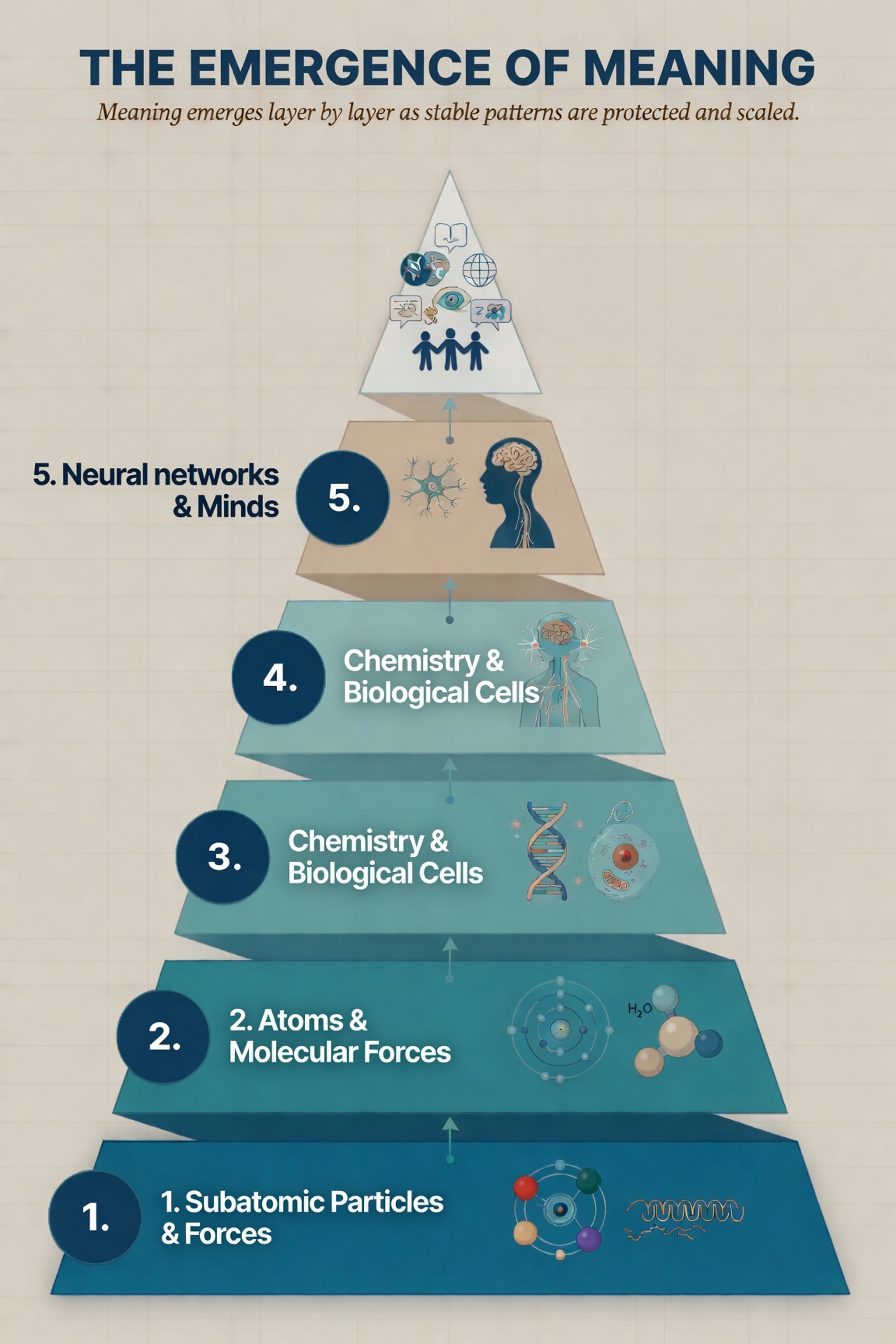
Figure 2: Stabilized regularities build upward through repeated compartmentalization at every scale. Emergent higher-level interaction capabilities — the key output that enables scaling — arise as the same triad (parts interacting, container forming, stable pattern persisting) recurs at every level.
Biology Makes It Easy to See
Cells are the clearest example.
A cell is not just chemicals floating around. It is chemicals inside a membrane. That membrane is not decoration. It is a boundary that protects the interaction pattern needed for life: energy conversion, repair, signaling, replication.
Without the boundary, reactions disperse. With the boundary, reactions accumulate and coordinate. The membrane allows enough inward focus for a stable pattern to persist — and that persistence confers new interaction capabilities on the cell as a whole, letting life do more than flicker momentarily and vanish.
In plain language: life needs a room.
The same principle applies in human life.
Attention needs a room. Trust needs a room. Learning needs a room. Recovery needs a room.
No room, no continuity.
What This Looks Like in Real Life
Think of the last time you were trying to focus on something important but had constant interruptions — notifications, drop-by conversations, competing obligations. That is not a motivation problem. That is a container problem. The boundary that should protect focused attention had too many leaks. Fixing the boundary — closing the door, setting the phone to silent, blocking the calendar — often does more than trying harder.
Figure 3: Compartmentalization Process
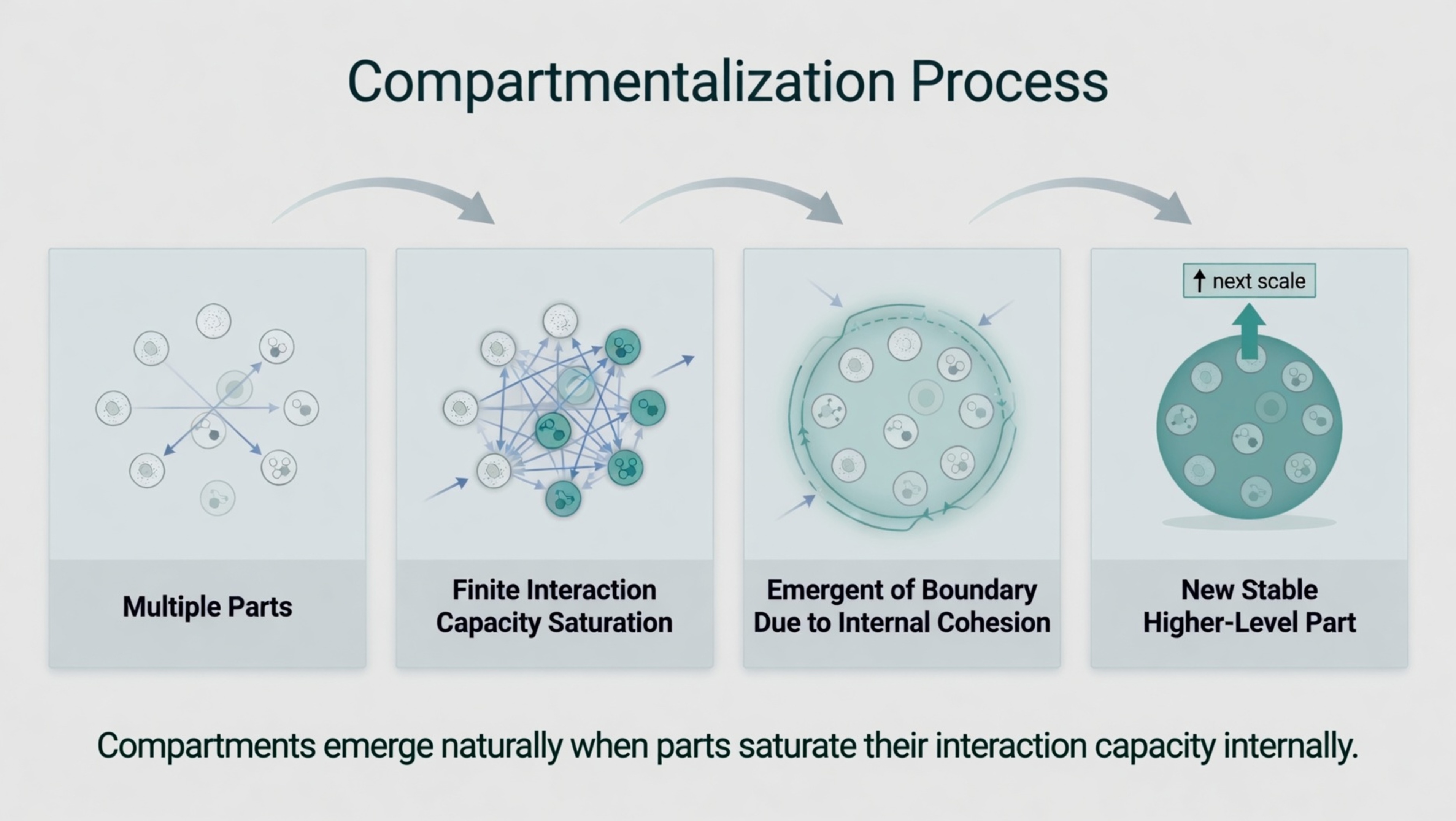
Figure 3: The Compartmentalization Process. Repeated interaction + finite capacity → protective container → stable pattern → new higher-level part with emergent interaction capabilities that enable further scaling.
This same logic scales one level higher when we look at the evolution of nervous systems. Simple organisms react directly to their immediate chemical environment. But at some point, certain lineages evolved a new kind of container: a nervous system. This was not just another membrane. It was an internal gap — a space between sensory input and motor output — whose entire purpose was to detect recurring patterns in the environment, remember them, and use them to predict what would happen next.
The advantage was enormous. An organism that could notice “when the shadow appears, the predator is near” or “when the days grow shorter, food will become scarce” could prepare in advance instead of reacting after the fact. Even very simple nervous systems show this capacity. Roundworms, with only 302 neurons, can learn that something is harmful and retain that memory long enough to change their behavior for hours. Bees, with roughly one million neurons, build detailed mental maps of flowers across square kilometers, take shortcuts, and even teach the location of food sources to others through dance. The better the internal model matched the actual recurring patterns of reality, the greater the survival advantage.
Brains, in other words, evolved as pattern-detection and prediction machines — precisely because reality itself is full of stable, repeating patterns. This evolutionary step completes the hierarchy. The Thread does not leap from chemistry straight into culture. It moves through the emergence of nervous systems — internal modeling layers built to exploit the very regularities we have already seen at lower levels. The brain creates a layer between the organism and the raw environment: sensory input is processed one step removed, then the organism reacts based on its model rather than raw sensation. Anyone with a better model has more power. Animals have ideologies. Humans have ideologies. They are simply different qualities of world-model.
Stability Thresholds: Where Patterns Hold or Break
Not every arrangement survives. Reality acts as a constant filter.
At every level, configurations are constantly being tested. Most are fleeting. Only those that cross a critical minimum — a stability threshold — persist long enough to become reliable building blocks for the next level. Below the threshold, the pattern decomposes and returns to disorder. Above it, the arrangement holds and can be handed upward.
This is the quiet operation of the Stability Drive. And the process by which reality tries countless configurations and keeps only the ones that endure — from subatomic particles to civilizations — is what this book calls the Grand Search.
The same gatekeeping appears in everyday life:
- A marriage may need protected time, conflict-repair skills, and financial honesty. Below that threshold — over time — the pattern degrades.
- A body may need sleep, movement, and metabolic stability. Below those minimums, health erodes regardless of intention.
- A team may need role clarity, psychological safety, and honest communication. Without them, even talented people eventually disengage.
- A personal practice may need realistic frequency and low activation energy. Heroic willpower cannot substitute for a good container.
This is why sincerity alone is not enough. Structure matters. Threshold conditions are not optional extras. They are the load-bearing walls.
Figure 4: Stability Thresholds
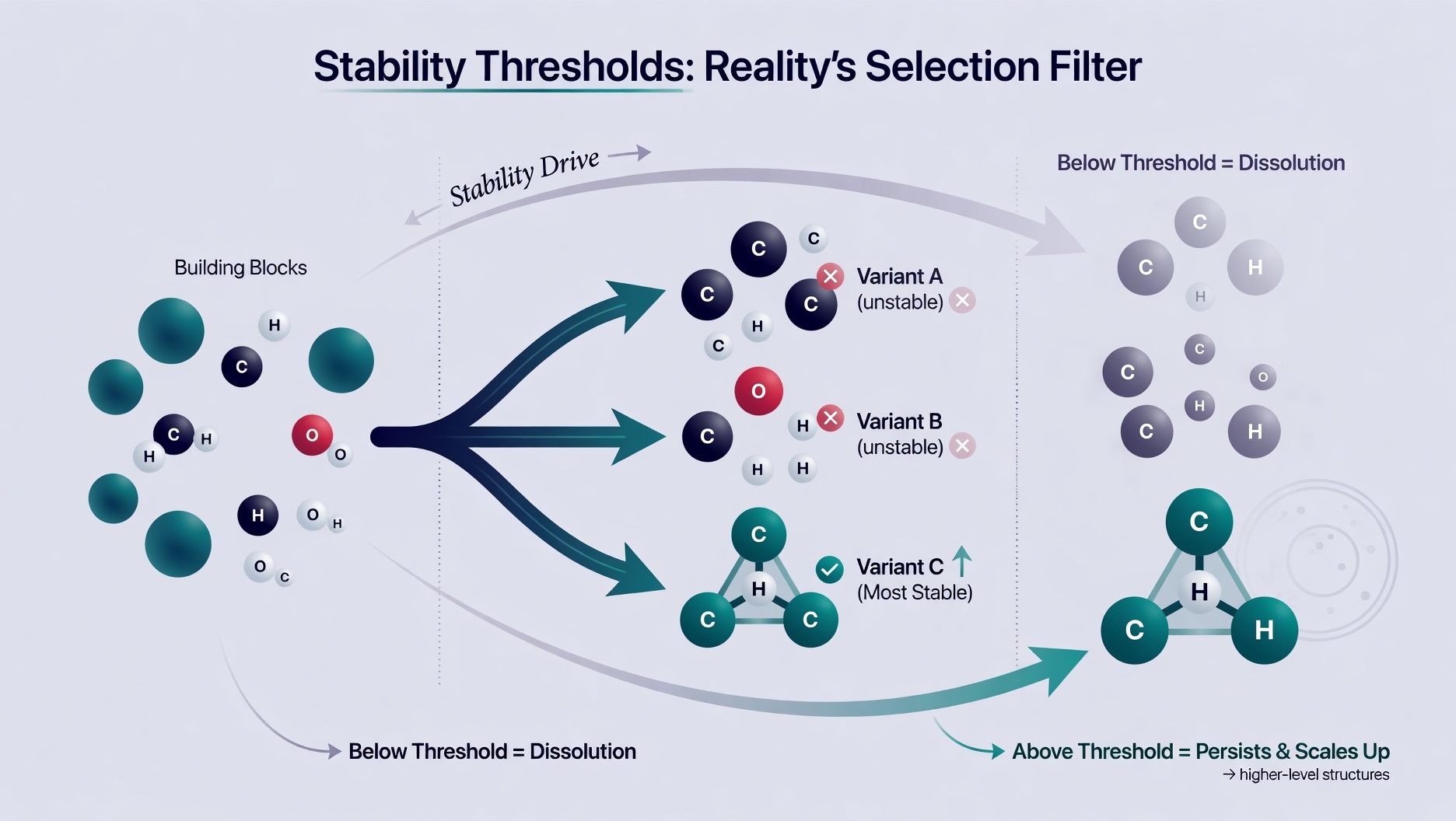
Figure 4: Reality acts as a filter; only configurations that cross the stability threshold persist long enough to gain emergent capabilities and scale upward.
What This Looks Like in Real Life
A person trying to maintain a meditation practice while sleeping five hours a night and working sixty-hour weeks is operating below the threshold conditions for that practice. More discipline will not save it. Redesigning the surrounding container — sleep, schedule, energy — is the move that makes the practice viable. Start below the threshold, and even good practices collapse. Start above it, and even modest practices accumulate into something durable.
Mind and Identity: Containers in Psychological Life
Your mind is also a pattern-maintaining system with limited bandwidth.
If every signal had equal claim on your attention, you would fragment. So the brain filters, prioritizes, predicts, and compresses. Over time, it builds a world-model: what is safe, what is dangerous, what matters, who I am, what kind of future is possible (Suryanarayana, Robertson, and Grillner 2022; Krapp 2010).
This model is not formed once. It is updated through repetition, relationship, narrative, and feedback. And it depends on protective psychological containers:
- sleep and recovery rhythms,
- trusted relationships,
- routines that regulate stress,
- language that makes experience coherent,
- environments that reduce constant threat.
When those containers are damaged, identity becomes noisy and unstable. When they are maintained, people gain the surplus needed for reflection, creativity, and ethical choice.
The brain also does something remarkable: it can simulate futures. It can imagine patterns that do not yet exist. This capacity — to decouple sensory input from immediate action and rehearse possible responses instead — is the foundation of planning, empathy, art, and moral reasoning (Garcia-Pelegrin, Wilkins, and Clayton 2021).
So even the richest forms of inner life follow the same logic: protected regularity first, then higher freedom.
Figure 5: Brain as Simulator
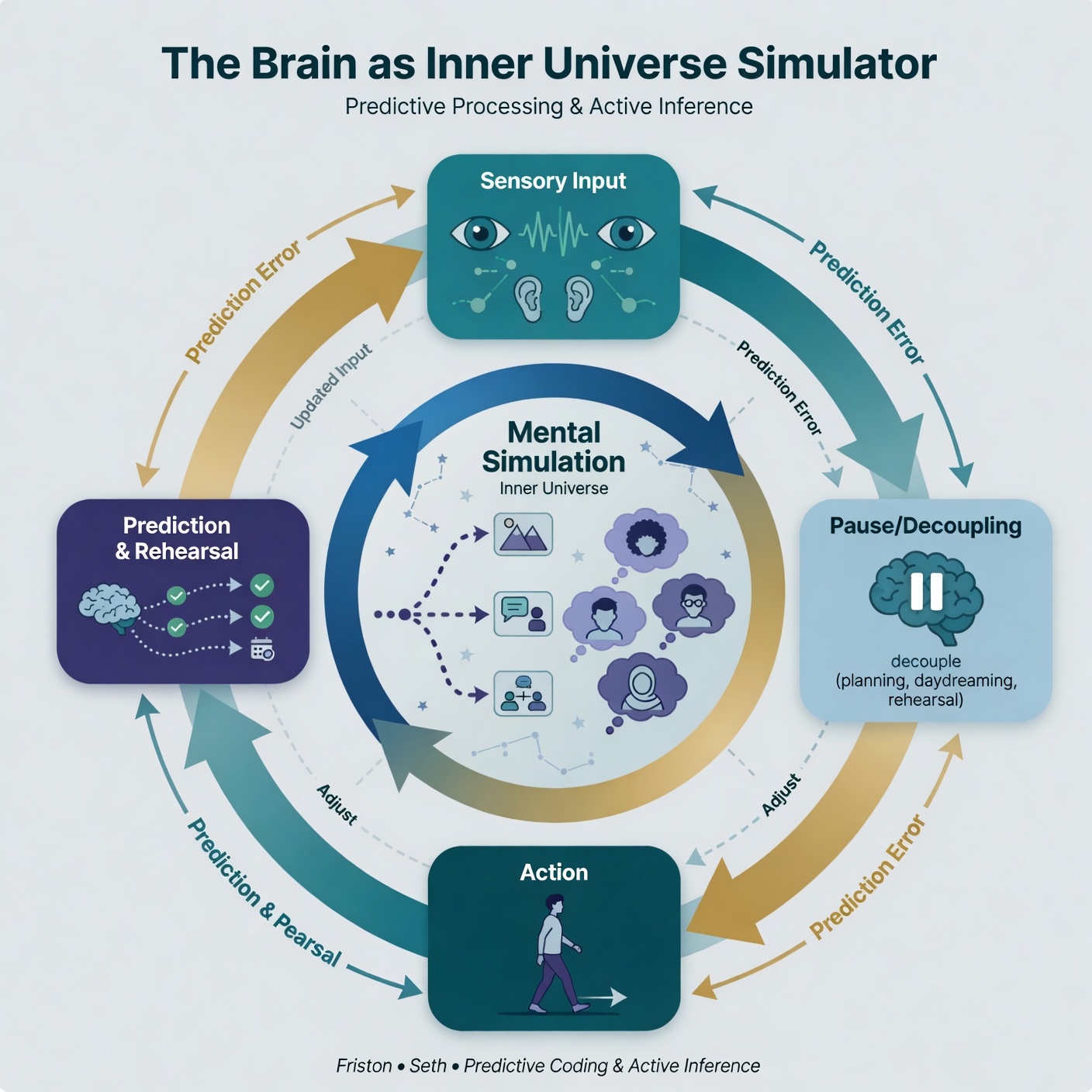
Figure 5: The brain decouples input from action, creating space for mental simulation, prediction, and rehearsal.
Culture and Institutions: Shared Containers
At the social level, institutions do what membranes do at the biological level. They create durable boundaries for cooperation.
Good institutions protect norms of honesty, role clarity, fair process, rituals of belonging, and mechanisms for repair when trust is broken. These are not abstract ideals. They are load-bearing structures — the containers that keep shared meaning alive under pressure.
When a school, company, or community loses boundary quality, interaction quality drops. Noise rises. Coordination decays. Cynicism replaces trust. People call this “culture problems,” but structurally it is often container failure.
A shared meaning-system survives only if its container stays above the stability threshold — the minimum integrity required for patterns to endure. Below that threshold, collapse accelerates. Above it, renewal becomes possible.
Figure 6: Expanding Possibility Space
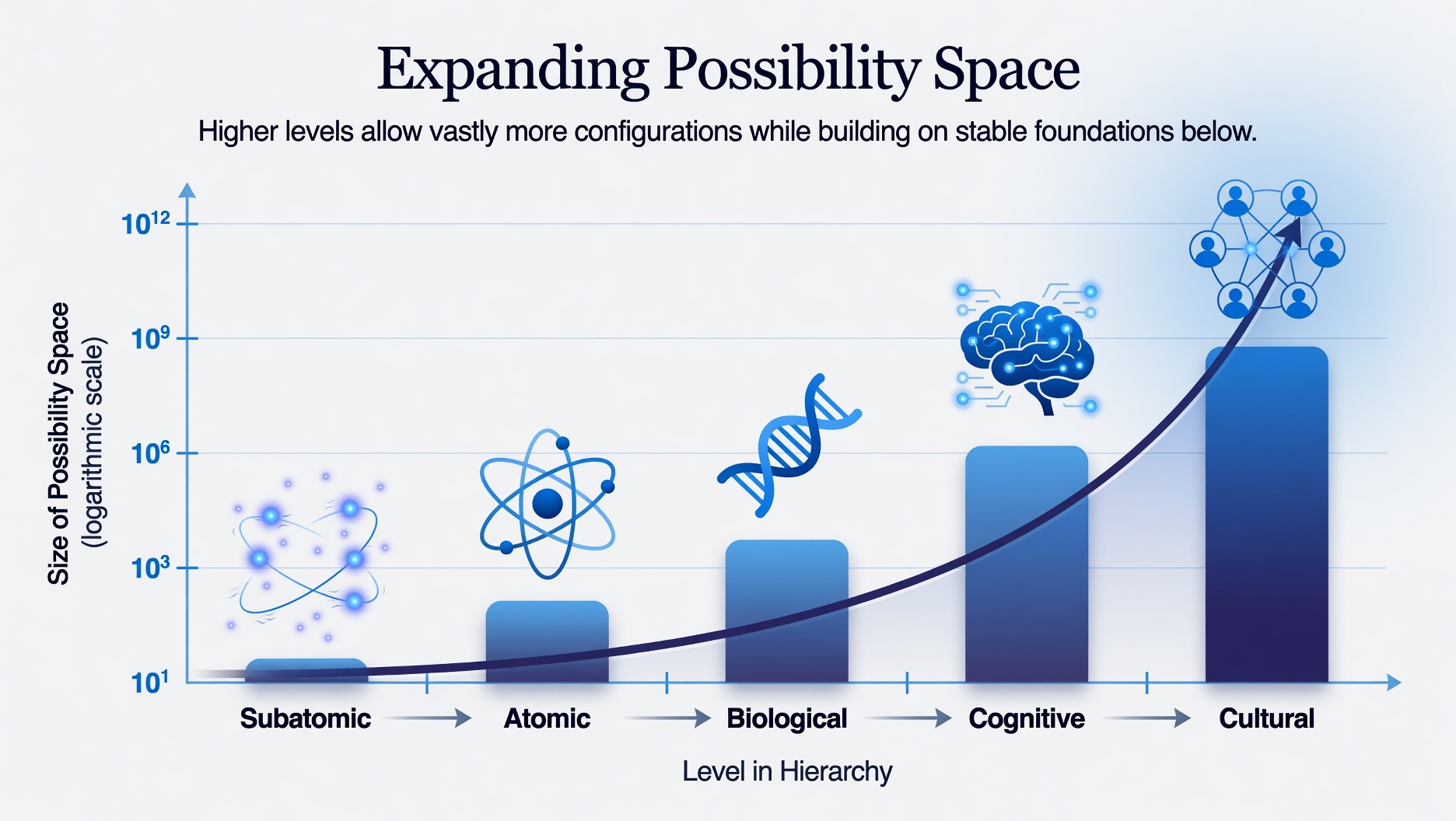
Figure 6: The space of possible configurations grows exponentially at higher levels of the hierarchy as emergent interaction capabilities unlock new forms of organization, while resting on stable foundations below.
Figure 9: Scales of Compartments
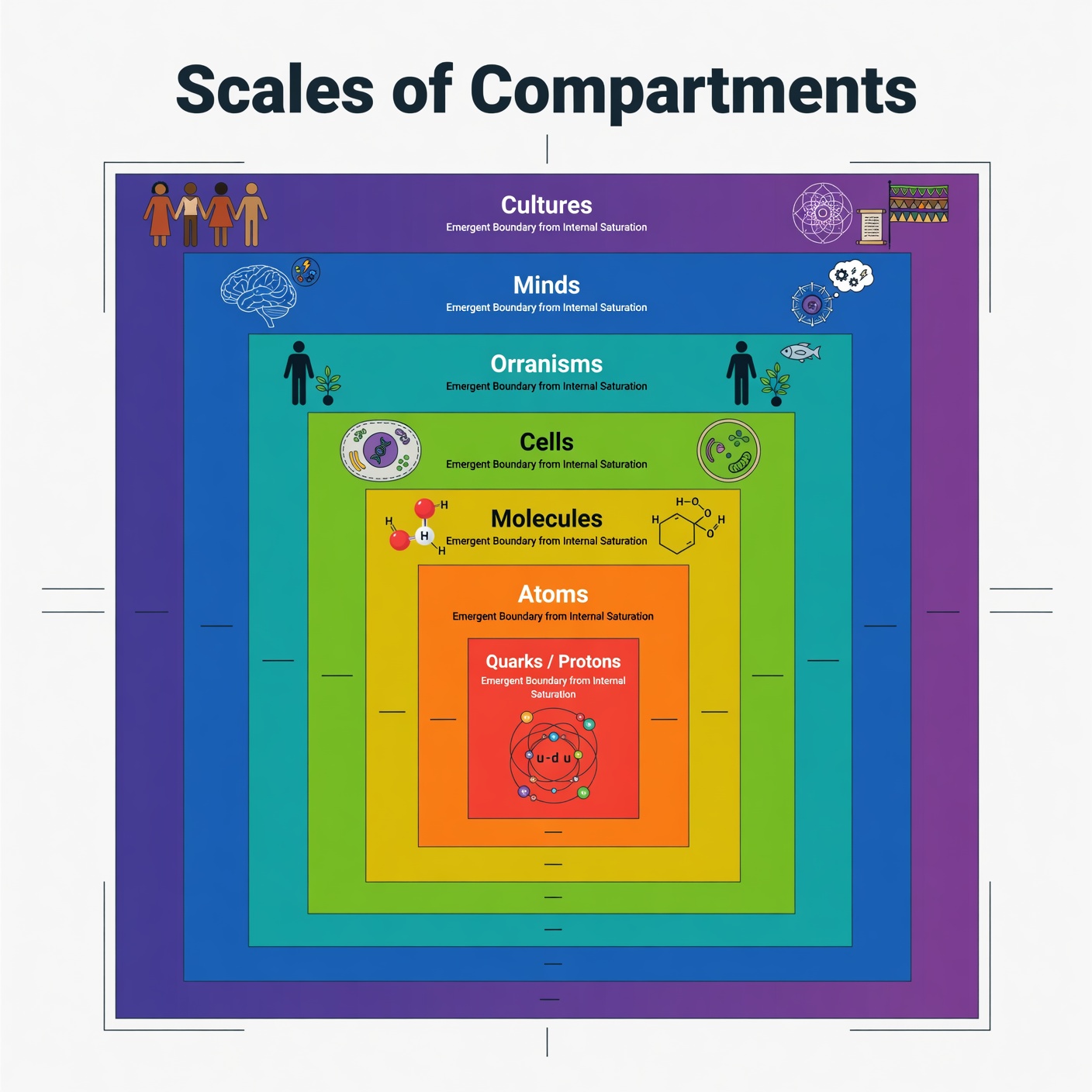
Figure 9: Compartments nest from subatomic particles to cultures, each level inheriting stability from below and gaining emergent capabilities that enable participation at the next scale.
Figure 10: The Grand Search
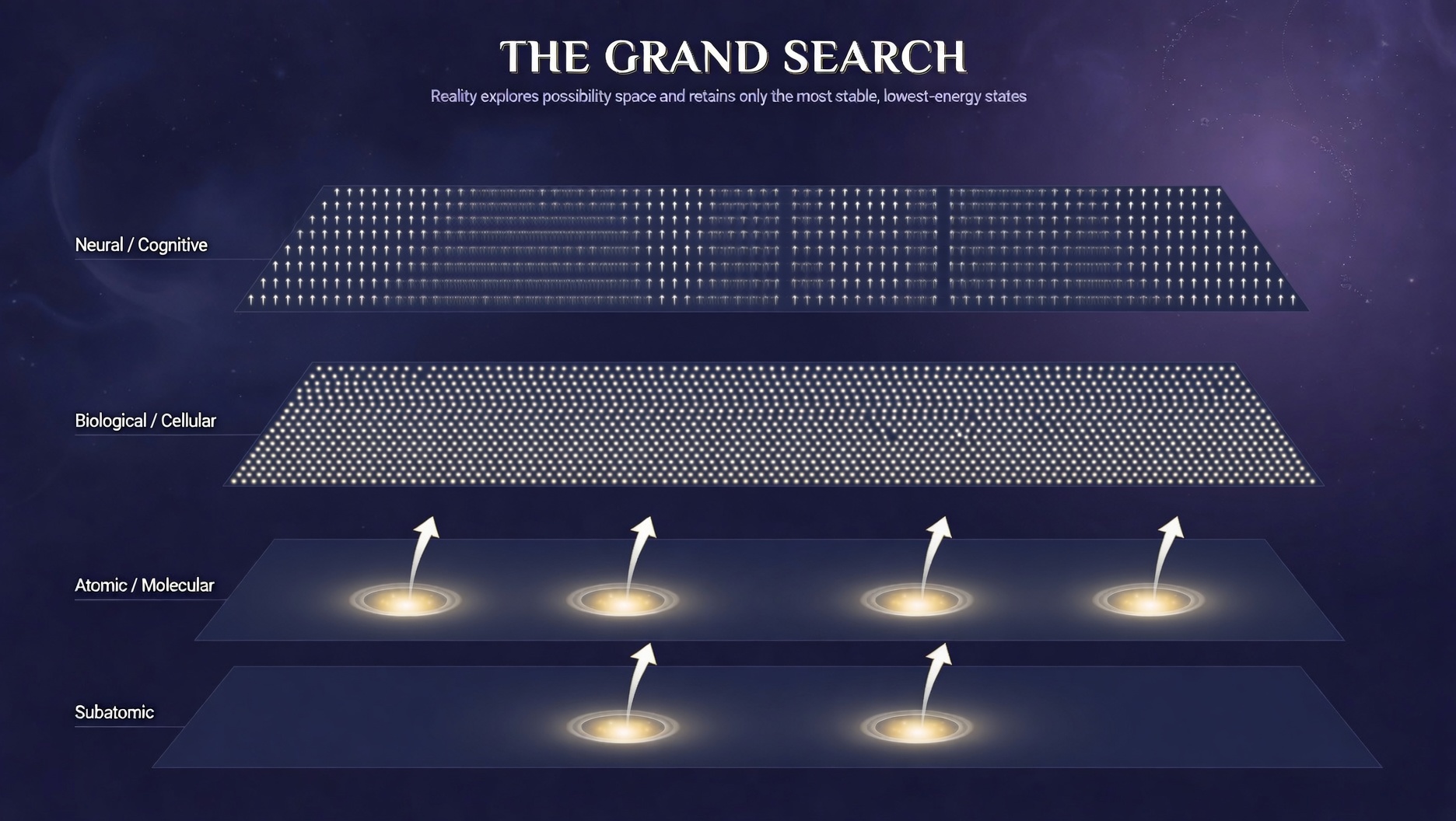
Figure 10: Reality explores vast possibility space and retains configurations stable enough to persist, confer emergent capabilities, and scale.
What This Looks Like in Real Life
A team whose meetings have devolved into status updates and venting has a container problem, not a people problem. The boundary that once protected honest thinking and real decision-making has eroded. The fix is rarely a motivational talk. It is redesigning the container: clearer purpose, smaller attendee list, explicit norms for how conflict gets handled, and a closing ritual that creates accountability.
A Brief Look Downward: Subatomic Continuity
We can now complete the picture by looking in the other direction — all the way down.
Even at the smallest scales physicists have found, stable wholes emerge from interactions that focus inward. One vivid image: quarks are held together so tightly by the strong nuclear force that they form protons — extraordinarily reliable units with interaction modes unavailable to isolated quarks, becoming dependable building blocks for everything above them. The container here is not a membrane; it is a field of force so binding that the “parts” never exist in isolation. The result is the same: protected interaction produces stable pattern, confers emergent capabilities on the compound, and the new part can participate at the next scale.
The technical details are preserved in full in Appendix A for those who want the scientific depth. The conceptual point here is enough:
Nature keeps what can hold together.
That is the same logic we have already seen at the dinner table, in a gaming group, in a cell membrane, and in a well-run institution. The pattern is not metaphor. It is structural continuity across scale.
What This Chapter Means for the Rest of the Book
If Chapter 1 showed that humans have always relied on recurring patterns, Chapter 2 gives you the mechanism — the why behind the strategy.
Meaning is not only emotional intensity. It is durable organization. It is what happens when finite capacity is allocated in ways that protect valuable patterns over time — and when those patterns, once stable, unlock emergent capabilities that let the weave continue at the next scale.
This does not reduce love, purpose, faith, art, or moral life. It gives them a scaffold.
A warm, full human life still needs architecture.
And once you can see the architecture, you can begin to design it more deliberately — which is exactly what the rest of this book is about.
Key Takeaways
- Meaning grows when useful patterns are stabilized and protected across time.
- Every system has finite capacity, so boundary design is not optional.
- Protective containers (compartmentalization) emerge naturally when interactions focus inward — they are not imposed from outside.
- Stable patterns at one level become building blocks for the next level up, conferring emergent capabilities that enable genuine scaling.
- Stability thresholds determine whether a pattern can endure; sincerity alone cannot substitute for meeting them.
- The same organizing logic appears at every scale — from subatomic particles to personal identity to institutions — making The Thread a genuinely cross-scale diagnostic tool.
- The practical move is always the same: protect the conditions that let valuable patterns survive.
Garcia-Pelegrin, Elias, Callum Wilkins, and Nicola S. Clayton. 2021. “The Ape That Lived to Tell the Tale: The Evolution of the Art of Storytelling and Its Relationship to Mental Time Travel and Theory of Mind.” Frontiers in Psychology 12: 755783. https://doi.org/10.3389/fpsyg.2021.755783.
Krapp, Holger G. 2010. “Sensorimotor Transformation: From Visual Responses to Motor Commands.” Current Biology 20 (6): R223–24. https://doi.org/10.1016/j.cub.2010.01.056.
Suryanarayana, Shruti M., Brita Robertson, and Sten Grillner. 2022. “The Neural Bases of Vertebrate Motor Behaviour Through the Lens of Evolution.” Philosophical Transactions of the Royal Society B: Biological Sciences 377 (1844): 20200521. https://doi.org/10.1098/rstb.2020.0521.