Chapter 1: The Roots of Regularity
Picture a pre-dawn morning several thousand years ago.
A village elder stands at the edge of a field, watching the horizon. She has been watching the same horizon for forty years. She knows something the younger farmers around her do not yet fully know: the river will rise in exactly this many days. She knows it not because someone told her. She knows it because she has watched, counted, and remembered long enough to trust the pattern.
That knowledge will feed a hundred families this year.
This is where meaning begins: not in philosophy, not in scripture, but in the quiet act of noticing that something comes back.
Patterns in the Sky and Soil
Long before we had theories, we had returning things: stars, floods, migrations, harvests, fires lit at the same season each year. Human beings learned early that recurrence could be trusted. And whatever could be trusted could be built into life.
Once an observed pattern became reliable, something remarkable happened. People began to protect it. They built structures — physical, social, and symbolic — to preserve the knowledge across generations. Stonehenge and the Maya Long Count were not mere timekeepers. They were technologies of meaning: ways of converting the apparently random into the predictable, the unseen into the actionable (Aveni 1997; Krupp 1997). A calendar tied to the Nile’s flooding cycle meant the difference between an organized planting season and famine. Celestial observation became civic infrastructure.
In Mesopotamia, Egypt, the Andes, and East Asia, civilizations invested enormous effort in aligning daily life with these celestial regularities. Astronomical knowledge linked to agriculture, ritual, and political order. As archaeoastronomers Anthony Aveni and E. C. Krupp have shown, these systems turned observed regularities into durable shared practice (Aveni 1997; Krupp 1997). The cosmos was not just beautiful. It was useful — and it was legible, if you paid close enough attention.
What This Looks Like in Real Life
A modern family that eats dinner together most evenings is doing something structurally similar to those ancient farmers. The recurring pattern creates predictability. Predictability creates trust. Trust creates the safety where real conversation becomes possible. The “calendar” here is just a shared agreement that Tuesday evenings belong to the family table.
Social rhythms received the same careful treatment. Kinship systems, initiation rites, and seasonal festivals created repeatable practices that protected interaction. A village bell or a call to prayer did more than mark hours. It synchronized attention, reinforced identity, and allowed continuity to persist beyond individual lives.
Aboriginal songlines encoded law, geography, and ecology in sung pathways. Inca ceque lines radiated from Cuzco like spokes of a ritual wheel, binding empire, astronomy, and ancestry (Berger and Luckmann 1966; Giddens 1984). These were early protective containers: boundaries of practice that turned fleeting events into durable social reality. The pattern was not only observed. It was institutionalized.
Three Scenes of Meaning-Making
Scene one: Sky and soil alignment. Imagine the moment a Mesopotamian astronomer records the eighty-third consecutive year in which a particular star rises at the same angle before the harvest. The community no longer needs the astronomer to be present at every planting. The pattern has been preserved in writing, in ritual, in collective memory. The calendar, for the first time, outlasts its creator.
Scene two: The synchronizing bell. A medieval European town has a bell tower. Every morning at the same hour, every midday, every evening — the bell rings and the town breathes together. People wake, stop, gather, and rest in unison. The bell does not tell people what to think or feel. It simply creates a shared rhythm inside which thought, work, and community can unfold.
Scene three: The modern household. A family has a Sunday morning walk. Same route. Same time. Sometimes coffee from the same café. Over months, the walk becomes a container for difficult conversations, small celebrations, shared silence. The ritual holds relationships together not by being dramatic, but by being repeated.
What This Looks Like in Real Life
Look at the recurring rituals in your own week — the standing coffee with a colleague, the evening call with a parent, the gym session on Tuesday and Thursday. These are not just habits. They are small containers that keep patterns alive: the pattern of trust, care, connection, and self-regulation. Their value is often invisible until they are disrupted.
Philosophers and Storytellers as Early Theorists
Thinkers across traditions elevated this intuition into explicit philosophy. Aristotle saw the regular motions of the heavens as evidence of inherent purpose (telos) and the foundation of natural science (Aristotle, n.d.). In China, the concept of li (ritual) positioned repeated human practices as the earthly mirror of heavenly dao, harmonizing individual conduct with cosmic pattern. Greek myths personified planetary wanderers. Vedic hymns celebrated the ordered sacrifice that sustained the universe. Norse cosmology linked the world-tree Yggdrasil to rhythmic fate.
What all these traditions shared was an intuition: the cosmos has a reliable structure, and wise humans align themselves with it.
Carl Sagan captured the enduring wonder: the regularity of the cosmos stirs in us the desire to understand our place within it. “We are a way for the universe to know itself” (Sagan 1985). Whether through Babylonian star catalogs, Greek philosophy, Indigenous songlines, or modern cosmology, the impulse is the same — recurring patterns provoke existential questions and invite us to build frameworks that make those patterns usable for collective life.
Regularity as Humanity’s First Technology for Meaning
What these traditions reveal is that regularity alone does not produce meaning. It must be noticed, interpreted, institutionalized, and transmitted. The deeper pattern is not merely that order exists in nature, but that stable order — preserved by reliable human practices — becomes the scaffold for interpretation, identity, and coordinated action.
Calendars enabled agriculture and governance. Rituals created belonging. Stories turned the cosmos into a moral stage. This intuitive strategy — observe, encode, repeat, transmit — worked for millennia. It still does.
The calendar, the rite, and the story were early vessels. Their quiet mission was to protect stable patterns from slipping back into chaos. Every functioning family, team, and institution today does something structurally identical — even if the rituals are as modest as a standing meeting or a morning routine. These protective containers do more than create stability — they enable the formation of higher-level entities with new interaction capabilities. A shared family rhythm, for example, creates not only belonging but new collective coordination abilities unavailable to isolated individuals.
Figure 1: Regularity Formation Cycle
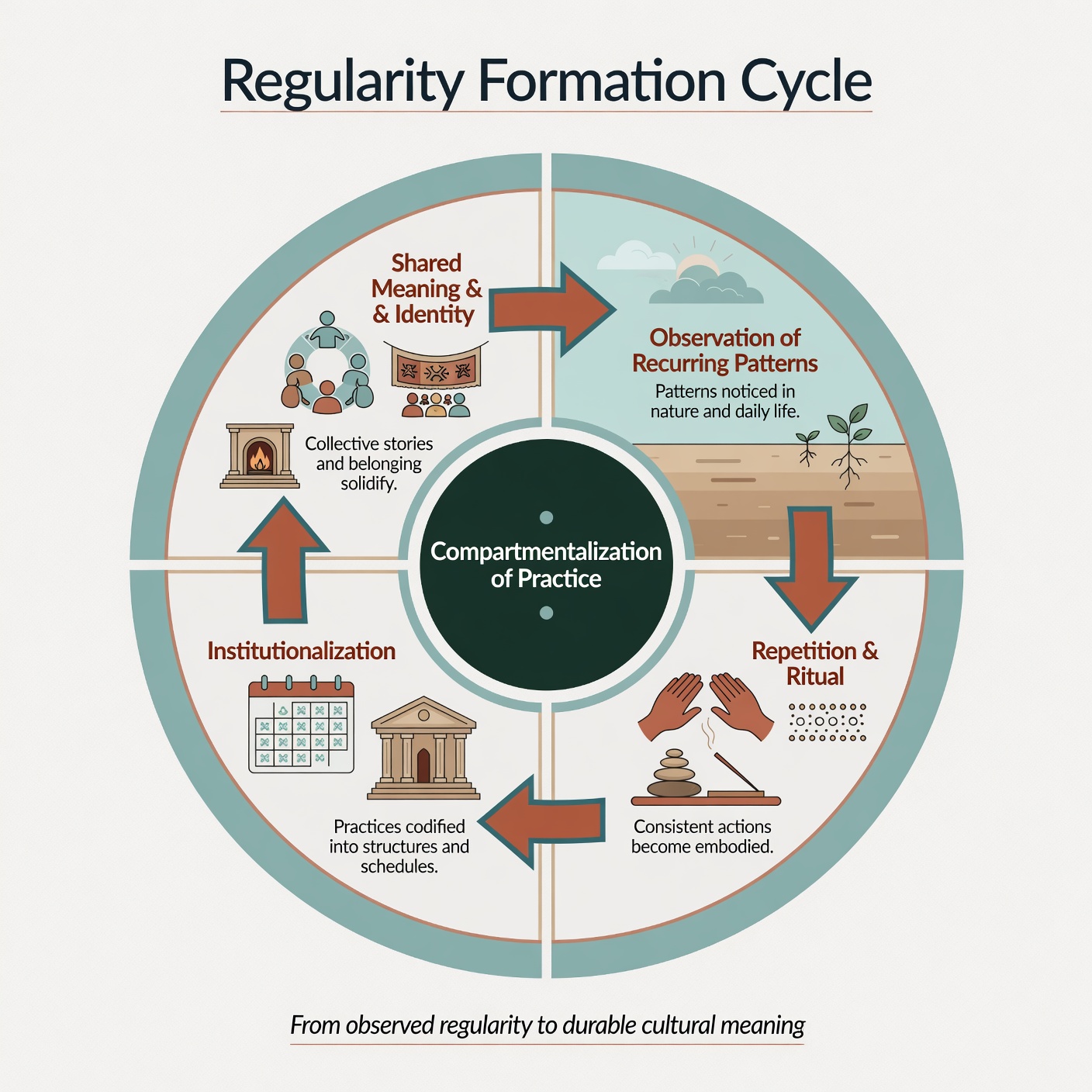
Figure 1: How human societies transform observed regularities into shared meaning through repeated practice and protective containers.
Why Religions Endure
Religions endure because they solve a real design problem. They gather people, stories, symbols, and rituals into repeatable practices protected by time, place, and norm. Those boundaries keep patterns alive across generations.
John Vervaeke describes the experiential side of this: people need practices that restore relevance, belonging, and fittedness in the world. This book adds the structural side. Meaning lasts when a pattern can be repeated, renewed, and repaired.
The historical lesson is straightforward: calendars, rites, and institutions worked because they stabilized valuable order. They protected useful patterns. They gave finite human beings — limited in time, energy, and memory — a way to preserve what mattered beyond any individual life.
What This Looks Like in Real Life
A secular person who still attends family religious ceremonies is often doing something wiser than it might look. Even after the explicit beliefs have changed, the underlying container — shared attention, inherited story, gathered family, marked transition — still performs real work. Dismissing the ritual entirely often discards the container along with the doctrine. The Weaver’s move is more careful: keep what stabilizes life, revise what harms it.
A Bridge to What Comes Next
Still, intuition can only take us so far. Older frameworks often mixed careful observation with supernatural explanation, and they lacked a clear language for how meaning scales upward from one level of reality to the next.
Chapter 2 builds that bridge. It takes the ancient intuition — protect the pattern, and life becomes livable — and gives it a cleaner, evidence-based model, including how each stable compound gains emergent interaction capabilities that let the weave continue upward. That model is what lets us move from inherited insight to deliberate practice.
We have trusted these patterns for millennia. Chapter 2 shows precisely why they work — and how you can apply the same logic to your own life.
Key Takeaways
- Humanity’s oldest strategy for meaning has been to notice recurring patterns in nature and society, then stabilize them through shared practices.
- Calendars, rituals, stories, and institutions functioned as early protective containers, turning ephemeral observation into durable coordination and shared identity.
- Regularity is not decorative; it is the fundamental medium in which meaning is written.
- The task of the modern era is to understand the mechanics of these containers so we can wield them more consciously — and that is the purpose of the lens this book calls The Thread.
Aristotle. n.d. Metaphysics.
Aveni, Anthony F. 1997. Empires of Time: Calendars, Clocks, and Cultures. University Press of Colorado.
Berger, Peter L., and Thomas Luckmann. 1966. The Social Construction of Reality: A Treatise in the Sociology of Knowledge. Penguin.
Giddens, Anthony. 1984. The Constitution of Society: Outline of the Theory of Structuration. Polity Press.
Krupp, E. C. 1997. Skywatchers, Shamans and Kings: Astronomy and the Archaeology of Power. John Wiley & Sons.
Sagan, Carl. 1985. Contact. Simon; Schuster.