
Listen to this article
Why Your Gym Membership Collects Dust
A Weaver’s Diagnosis of Exercise Habits
This piece uses a few simple ideas from the book Threads of Meaning. I’ll explain them in plain language as we go so you don’t need to have read the book.

Everyone already has a full set of habits and routines filling their day. Even “sitting on the couch scrolling after work” or “zoning out in the evening” is a real habit — a stable pattern that takes almost no effort and quietly supports parts of your current life and identity.
These existing habits act like protective containers (reliable boundaries or routines that keep a pattern alive and protected). They use up your finite capacity — your limited daily supply of time, energy, and attention — and in return they stabilize something you value: rest, small excitements, connection, or a sense of “I’ve earned this.”
When you decide to add regular exercise, you are not simply adding a new activity. You are trying to weave a new thread into an already full system.
The Hidden Cost Most People Don’t See
Before any activity becomes a true, automatic habit, it goes through a difficult early phase. During this time it demands real conscious effort. You have to carve out protected time and space, show up even when you don’t feel like it, and keep going even though you’re not seeing big results yet.
Only after many repetitions does the habit cross a stability threshold (the point where it stops feeling like hard work and starts feeling natural and self-sustaining). At that point it shifts from high-effort investment to much easier maintenance. Most people who look “naturally consistent” at the gym are already in this easy maintenance phase. What you see is the finished result — not the cost it took to get there.

Why Most People Fail
1. Wrong Expectations (The Maintenance Illusion)
You see fit people who seem to enjoy exercise with almost no effort. So you expect the activity to quickly give you energy, clarity, and visible results. In reality, for the first several weeks (sometimes months) you will mostly be giving energy with very little return. This gap between what you expect and what actually happens is where most new habits die.
2. Wrong Approach: Trying to Add Without Removing (Overstretch)
Your day is already full. Every new habit needs new protected space. That space has to come from somewhere.
Here’s the part most people miss: not all habits cost the same amount of energy.
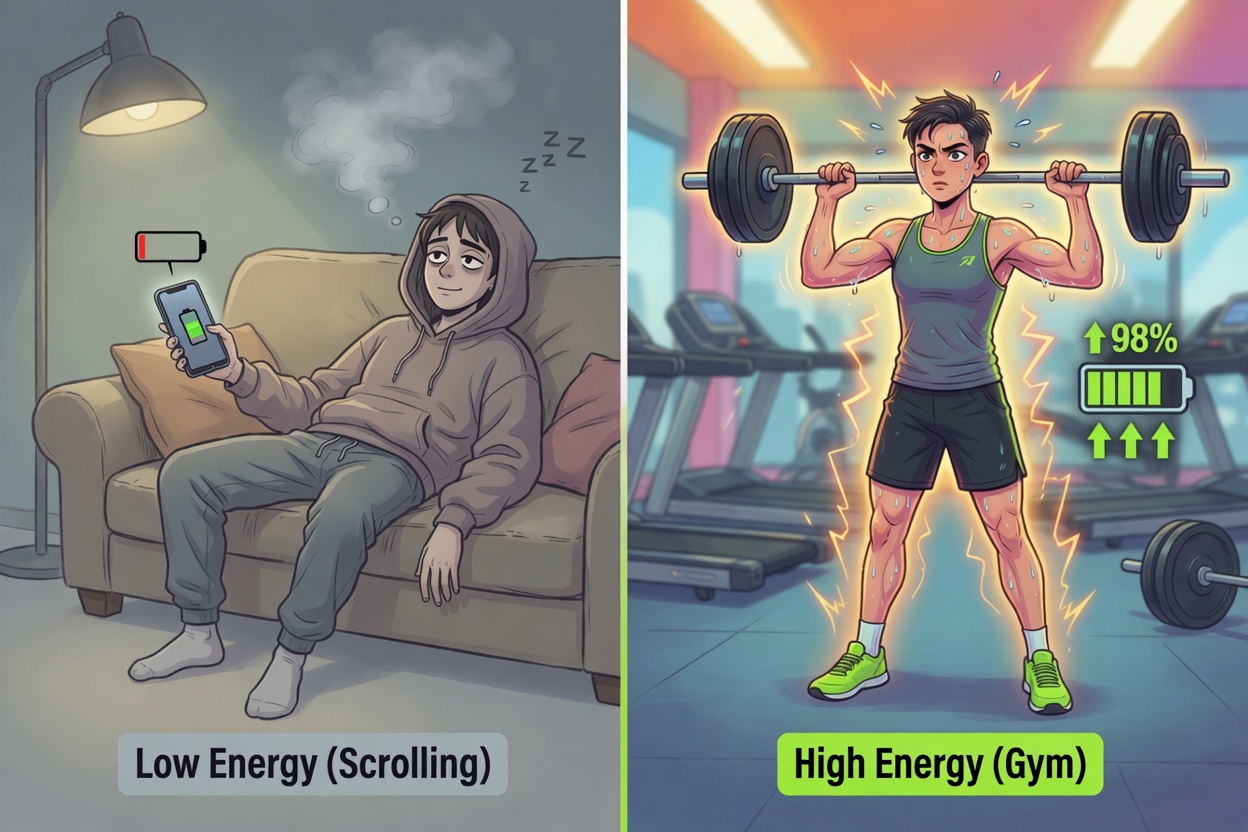
One hour of scrolling gives you small excitements and requires very little of your high-quality energy — the kind you need for work, deep conversations with family, or showing up well for friends. It’s a low-cost habit in terms of real energy drain.
One hour at the gym (especially if you’re pushing yourself) consumes real, high-value energy. After that hour, you may have already spent the energy you needed to stay sharp at work, be emotionally present with your partner or kids, or maintain important relationships.
So when people say “just swap one hour of scrolling for one hour at the gym,” they’re missing something important. You’re not trading equal things. You’re trading a low-energy habit for a high-energy one. This often means you have less capacity left for the parts of life that actually matter most to you.
This is what the book calls overstretch — trying to force new demands into a system that’s already running at full capacity. The new habit never gets enough consistent energy to stabilize, and other important areas of life start to suffer quietly.
3. The New Habit Never Builds Its Own Strength
For a habit to last, it eventually needs to create its own self-reinforcing container — a reliable rhythm or structure that protects it. This usually happens through repeated interaction (doing the same thing at the same time, in the same way, again and again) until the pattern becomes strong enough that small disruptions no longer break it.
If the new exercise habit stays weak and isolated (“I should really go to the gym sometime”), it often fails when life gets busy. But when it connects to other parts of your life — training with a friend, joining a small consistent group, tracking visible progress that reinforces who you want to become, or linking it to a deeper value — the container gets stronger. The habit gains support from multiple directions and becomes much more likely to endure.
The Weaver’s Path That Actually Works (With Honesty)
People who succeed with exercise over the long term usually do three things differently — and they are honest about the real cost:
- They accept the long investment phase with realistic expectations. They treat the first 8–12 weeks as “paying the real cost of building something new,” not as a test of whether the habit “works for me.”
- They are willing to consciously let go of something else — and they understand that what they let go of might be a real piece of their current life. Sometimes this means reducing time with certain friends or social activities that no longer fit the new rhythm. Sometimes it means building new relationships with people who support (or even share) the new habit. The Weaver is honest: if you cannot afford to reduce or let go of anything important, then this new habit may simply not be right for you right now. Only move forward if you are clear that the long-term value is worth the real cost.
- They deliberately strengthen the new habit by creating repeated, meaningful interaction — whether that’s social, personal, or identity-based.
The new habit doesn’t have to be rigid or all-or-nothing. After honestly reviewing your life and energy, you might realize you can’t sustainably go three times a week. That’s okay. Starting with just one day a week is still weaving a real thread. The trade-off becomes much less brutal, and you give yourself a much higher chance of actually succeeding. You can always increase the frequency later once the habit has stabilized and no longer drains you as much.
Your current life is supported by many invisible regularities — your workload, family situation, relationships, where you live, the seasons, and countless other things that keep everything running. Many people add a new habit during a brief window when everything feels stable. They invest heavily (expensive membership, big commitment) only for life to shift a few months later. Work gets busy, a family situation changes, or something unexpected happens — and the new habit has no buffer. It collapses because the foundation it was built on has shifted.
The Weaver thinks ahead: Before committing, ask yourself, “What if something changes? Will I still have enough buffer and resilience to keep this habit alive?” Don’t put your maximum energy into something right away. Start smaller, build gradually, and plan for the reality that life will not stay perfectly stable forever.


A Note on Personal Trainers and Stability Reservoirs
A personal trainer can make a huge difference in the early stages. They act as a stability reservoir — an external source of structure, accountability, and expertise that helps your new exercise thread cross the stability threshold much faster. Many people who finally succeed after years of failing do so with the help of a good trainer for the first 6–18 months.
However, there is an important long-term reality: if you rely on a personal trainer for many years, you are essentially using other resources and habits to keep this one habit alive. The exercise thread never becomes a fully independent, load-bearing part of your life. It remains dependent on external scaffolding.
The Weaver’s goal is eventually to stand on its own. A personal trainer can be excellent temporary support — like training wheels — but the real win is when the habit becomes strong enough to continue even when the trainer is no longer there.

The Living Thread: How a Gym Habit Creates an Entirely New Meaning
When the gym habit finally takes root and crosses the stability threshold, it creates something far more powerful than most people imagine.
We usually picture a robotic routine: you show up on time, finish your sets, and head home to continue the rest of your life unchanged.
In reality, the people who keep returning for years have built something alive. They know the regulars by name. They trade tips on improving form and recovery. They celebrate one another’s small victories and create a natural atmosphere of encouragement and connection. Friendships form. Conversations flow.
Like a tree that slowly sends its roots deep into the soil, these social threads give the new habit strength, stability, and life. From this living community often come unexpected opportunities, genuine support, and a quiet but powerful sense of belonging.
In the end, you don’t just gain a stronger body.
You gain an entirely new meaning woven into your days — one that enriches both your health and your spirit.
Key Weaver Reminder
Before you commit to building a new exercise thread, ask yourself honestly:
What real piece of my current life will I have to reduce or let go of? Am I truly willing to pay that price for the next 3–6 months while the habit is still forming? If the answer is no, that’s not failure — that’s clarity. The Weaver’s way is honest self-assessment, not forced heroism.